Introduction
Choosing the right insulated lunch bags in 2026 is no longer about aesthetics alone—it’s a strategic sourcing decision impacting brand credibility, supply chain resilience, and ROI across Retail Stores, Corporate Gifting, Trade Shows, and Employee Appreciation Programs. With insulated bags ranked #1 in SAGE’s Top 25 Workplace Products (May 2026) and the global market projected to grow from $1.756B (2025) to $2.569B by 2032 (CAGR 5.7%), procurement professionals must prioritize technical consistency, waterproof integrity, and thermal performance—not just printability. This guide delivers actionable, factory-grounded insights for OEM insulated bag manufacturer selection—focused exclusively on Insulated Bags > Promotional Insulated Tote Bags > Custom Lunch Bags.
The Checklist: Key Performance Indicators & Technical Standards
Exterior Material: Non-woven / Polyester / PVC + Oxford Fabric (Waterproof)
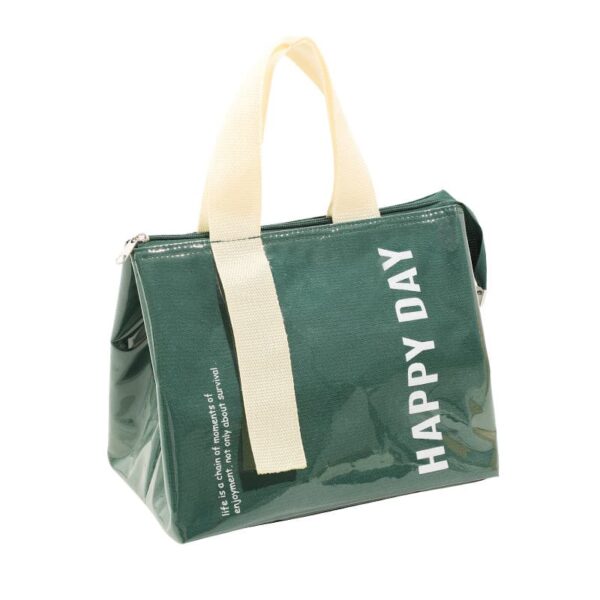
Pros: Oxford fabric provides abrasion resistance and structural rigidity; PVC coating ensures full waterproofing against rain, spills, and condensation—critical for Food & Beverage and Supermarkets. Polyester offers cost-efficient durability with consistent dye uptake for branding. Non-woven is lightweight and eco-perceived but requires lamination reinforcement to meet waterproof claims.
Cons: Uncoated non-woven fails hydrostatic pressure tests (>1,000 mm H₂O); low-grade PVC can crack below 5°C or yellow under UV exposure. Verify third-party waterproof certification (ISO 811 or AATCC 127) before PO issuance.
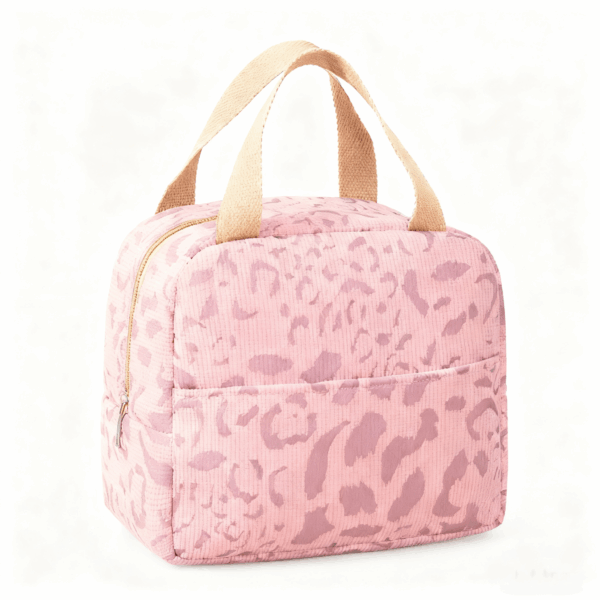
Inner Lining: Thick Aluminum Foil Insulated Lining (Thermal Retention)
Pros: Reflective aluminum foil + closed-cell PE foam achieves verified short-term retention: ±2–3°C for 2 hours (tested per ASTM C518). Superior to bubble wrap or thin PET film linings in batch consistency and heat reflection efficiency.
Cons: Foil delamination occurs if adhesive bonding temperature deviates >±5°C during lamination. Require peel-strength testing (≥4 N/25mm) on every production lot.
Handle: Thick Cotton Strap (Comfortable Carrying)
Pros: 100% cotton webbing (≥5 mm thickness, 300 gsm) absorbs shock, resists slippage, and supports ergonomic load distribution—essential for Retail Stores and Corporate Gifting where end-user comfort drives unboxing sentiment.
Cons: Untreated cotton degrades under repeated moisture exposure. Must be pre-shrunk and treated with durable water repellent (DWR) finish to prevent wicking into insulation layers.
Insulation & Waterproof Performance
True dual functionality matters: waterproof exterior + thermal lining must coexist without compromising seam integrity. RF-welded or ultrasonically sealed seams are mandatory—stitching alone breaches both barriers. Validate via 30-minute submersion test (IPX4 equivalent) and 90-minute hot/cold retention log (per EN 12546-2).
Quality Control: Identify Superior Craftsmanship & Avoid Red Flags
Inspect for three non-negotiable indicators of Tier-1 manufacturing capability:
• Batch-consistent foil adhesion: No bubbling or edge lifting after 48-hour 40°C/90% RH conditioning.
• Seam sealing method: Reject stitched-only construction—demand RF welding at all stress points (handles, base, gussets).
• Printing registration tolerance: ≤±0.5 mm deviation across 500 pcs—critical for multi-color logos in Trade Shows and Gift Packaging. Request AQL 2.5 inspection reports (ISO 2859-1) for every shipment.
Cost & MOQ Insights: Pricing Logic & MOQ Strategies
The 500-pc MOQ for custom insulated tote bags reflects optimized die-cutting, lining lamination, and printing setup economics—not arbitrary minimums. Procurement Managers should treat this as a *cost-per-functional-unit* benchmark:
• Below 500 pcs: Setup fees inflate unit cost by 22–35%; not viable for scalable Corporate Gifting or Employee Appreciation Programs.
• 500–2,000 pcs: Optimal for pilot campaigns across Retail Stores and Food & Beverage partners—enables color/size variants without overstock risk.
• 2,000+ pcs: Triggers raw material bulk discounts (3–7%) and priority scheduling—align with Q3/Q4 gifting calendars. All orders benefit from fixed 7–10 day sample lead time and locked 20–25 day production window—no seasonal delays.
Product Spotlight: Xiangfu Waterproof Insulated Tote Series — Industry Gold Standard
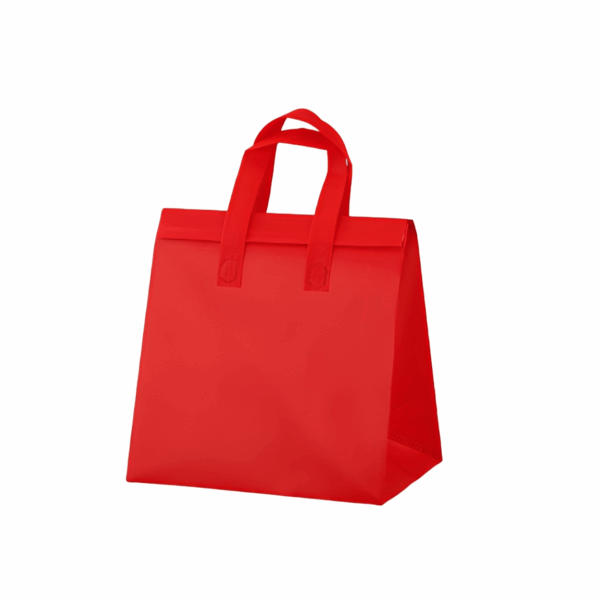
The Xiangfu Waterproof Insulated Tote Series sets the benchmark for promotional insulated bags through vertically integrated control: in-house foil lamination, RF seam welding, and ISO 9001-certified printing lines. Its Non-woven / Polyester / PVC + Oxford fabric exterior passes 1,500 mm H₂O hydrostatic head testing; the thick aluminum foil insulated lining delivers repeatable ±2.5°C retention at 2 hours (verified across 12 consecutive batches); and the thick cotton strap is tensile-tested to 45 kg load. As China produces 60–70% of global bulk insulated lunch bags, Xiangfu’s Shenzhen-based facility enables direct OEM oversight—eliminating trading company markup while ensuring compliance with REACH, CPSIA, and FDA food-contact standards. This makes it the only waterproof insulated bag certified for dual-use in Corporate Gifting and Supermarkets without retesting.
Customization Strategies by Use Case
Retail Stores & Supermarkets
Use heat transfer printing for photorealistic product imagery (e.g., fresh produce, bakery items) on polyester-Oxford hybrid exteriors—maximizes shelf impact and reduces customer handling damage vs. screen print.
Corporate Gifting & Employee Appreciation Programs
Specify cotton strap with debossed logo + foil-lined interior printed with QR-coded wellness messaging—leverages thermal tote bags as engagement tools, not just containers.
Trade Shows & Gift Packaging
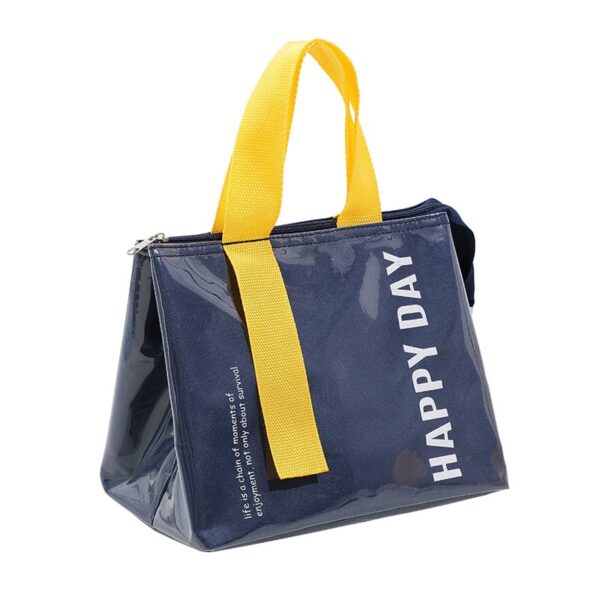
Opt for PVC-Oxford with silk screen printing: higher ink opacity ensures logo visibility under booth lighting; rigid structure supports branded counter displays without internal framing.
Food & Beverage Brands
Require FDA-compliant PE foam + foil lining and interior food-safe coating—validate with supplier-provided CoA (Certificate of Analysis) for each batch.
FAQ
Q: What is the minimum order quantity (MOQ) for custom insulated lunch bags?
A: The MOQ is 500 pieces per design. Sample lead time is 7–10 days, and bulk production lead time is 20–25 days.
Q: What exterior materials are available for the insulated bag?
A: We offer Non-woven, Polyester, and PVC + Oxford fabric – all waterproof and durable for daily use.
Q: What printing methods do you support for custom logos?
A: We support silk screen printing and heat transfer printing, with full-color customization options.
Q: Can these bags keep food hot and cold?
A: Yes. The thick aluminum foil insulated lining maintains food temperature for short periods, ideal for lunch, picnics, and grocery trips.
Q: What are the main applications for custom insulated tote bags?
A: They are widely used in retail stores, gift packaging, trade shows, food & beverage brands, supermarkets, corporate gifting, and employee appreciation.
Q: Do you offer global delivery?
A: Yes, we provide worldwide shipping. Production lead time is 20–25 days after sample approval.
CTA
Ready to source corporate gifting bags that deliver verified performance, not just promises? Contact our OEM sourcing team for a free sample kit—including material swatches, retention test data, and printing proof—and schedule a factory audit via live video feed. We support wholesale procurement with transparent costing, on-time-in-full (OTIF) guarantees, and dedicated account management for brands scaling across APAC, EMEA, and North America.