
A cooler bag sample is not ready for approval simply because it looks well made or feels insulated. For an OEM project, approval should mean that the buyer and supplier have agreed what the bag must do, under which conditions it will be tested, and what evidence will be retained with the approved sample. Without that agreement, two samples can be tested with different contents, different starting temperatures, or different opening routines and still produce results that cannot be compared.
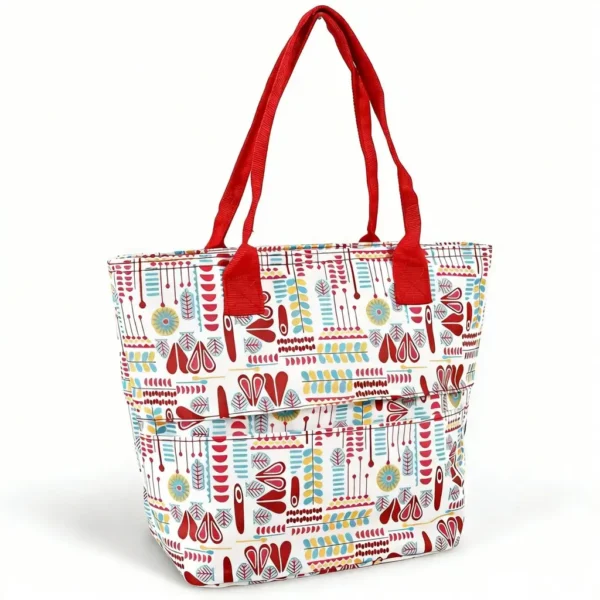
Xiangfu’s product page presents an insulated canvas tote bag as an OEM/ODM direction and lists customization for size, color, logo, and handle style. Its catalog also includes a Cooler Bags category. Those facts establish a suitable development starting point, not a pre-approved thermal specification. The useful next step is to convert the intended use into a written sample-validation brief before a purchase order or bulk-production sign-off.
Start with the acceptance question
The first line of the brief should state the decision the test is meant to support. For example: “Approve this sample for the agreed bag design and packout,” or “Compare two closure constructions before selecting the production version.” That wording is more useful than a general promise such as “keeps contents cool.” The acceptance question should identify the bag configuration, the planned payload, the cold source, the ambient exposure, and the measurement rule.
ASTM D3103’s public description addresses the thermal insulation performance of distribution packages and the thermal stability of their contents under variable ambient temperatures. It says performance is affected by the package’s insulation, energy source, and product payload. It also says testing should use the actual package whenever possible; when simulated contents or coolant are used, they should be as close as possible to the actual package in temperature and relevant physical properties. These points are useful for an OEM sample brief because they require the test to describe the complete packout rather than treating the empty bag as the test subject.
This does not mean that a canvas cooler tote is a distribution package certified to ASTM D3103. It means the standard’s publicly stated testing logic can help the buyer define repeatable conditions. The chosen conditions still need to match the product’s real commercial use and the buyer’s own acceptance decision.
A practical sample-validation brief
The following table is intended to be completed and signed before testing. “Buyer-defined” is deliberate: the correct value depends on the product, route, packout, and claim the buyer plans to make.
Agree who will perform the test, which instruments and environmental controls are available, who bears the test cost, and whether an independent laboratory is needed. Do not assume the manufacturer has a thermal chamber or a particular test capability simply because it offers cooler bags.
| Test item | Requirement to record before the test | Evidence to retain |
|---|---|---|
| Sample identity | Development code, revision, dimensions, color, logo artwork, handle version, closure version, and sample quantity | Dated photographs, drawing or specification sheet, supplier sample label |
| Ambient profile | Chamber or room set points, ramp/change sequence, tolerance, test duration, and whether the profile represents storage, display, delivery, or another use | Chamber log or calibrated data export; written rationale for the profile |
| Payload | Product or agreed surrogate, total mass/volume, container format, fill level, and placement inside the bag | Packout diagram, payload preparation record, pre-test photograph |
| Initial conditioning | Bag preconditioning, starting temperature of each payload component, and the time window between preparation and loading | Conditioning record and temperature log with instrument IDs and timestamps |
| Cold source | Type, count, mass or size, conditioning method, starting state, placement, and whether it is reusable or single-use | Cold-source preparation record and packout photograph |
| Bag setup | Closed/open state at start, orientation, support surface, and whether external packaging is included | Setup photograph and test worksheet |
| Opening pattern | Number and timing of openings, opening width or duration, operator method, and whether the bag is fully resealed | Opening log; video if the opening method is material to the decision |
| Sensor placement | Sensor locations in the payload and, if used, in the bag or ambient environment; attachment method; channel labels | Sensor map, channel list, calibration status, raw data file |
| Replication | Number of samples, number of runs, order of runs, and treatment of invalid runs | Run register and deviation log |
| Acceptance rule | Temperature metric, allowable range or limit, time basis, data exclusion rule, and who may approve a deviation | Signed acceptance sheet linked to raw data |
Define whether the decision concerns payload temperature, bag-air temperature, or both. An air reading alone does not establish the temperature of the contents. Keep channel-by-channel results and identify the agreed threshold crossings; an average should not conceal a failure that matters to the intended use. Food-safety or medical suitability requires a separate, use-specific assessment, not an inference from this development worksheet.
Change one variable at a time
A useful development comparison changes one material or use condition while keeping the rest of the brief fixed. If Sample A and Sample B have different closure designs, keep the bag dimensions, payload, cold source, ambient profile, starting temperatures, sensor map, opening pattern, and test order as constant as practical. The comparison then answers a narrow question: did the closure change alter the recorded result under this defined scenario?
The same logic can be used for a size revision, handle construction, lining construction, or logo treatment when the change could affect fit or packout. Do not compare a larger bag with a different payload and a different number of cold sources and then attribute the result to size alone. If the intended commercial use requires more than one packout, run separate predefined scenarios and label them separately rather than averaging incompatible conditions.
A simple comparison record can use this format:
| Comparison | Held constant | Single changed variable | Decision use |
|---|---|---|---|
| A vs. B | Same sample identity apart from the change, payload, cold source, ambient profile, sensors, and opening pattern | Closure construction | Select the closure for the next sample round |
| B vs. C | Same brief and packout | Bag size or internal configuration | Check whether the revised geometry supports the agreed packout |
| Selected sample repeat | Same approved configuration | No planned change; repeat run | Check repeatability before sign-off |
What sample sign-off should contain
Sample approval should be an evidence decision, not a visual impression. The sign-off pack should include the final specification or drawing, photographs of the exact tested sample, the completed packout diagram, preparation records for payload and cold source, the ambient and opening logs, the sensor map, calibration information, raw data, a short result summary, and a deviation list. The buyer should also record whether the result is approved for one named scenario, approved with conditions, or rejected for revision.
The approved sample itself should be uniquely marked or otherwise traceable. If a logo, color, handle, closure, or size changes after testing, the approval should not automatically transfer. The supplier and buyer should decide whether the change is cosmetic, structural, or packout-relevant and whether a repeat test is needed. A final sign-off should identify the sample revision, the test brief revision, the approving parties, and the date.
Procurement decision: approve, condition, or revise
Approve the sample only when the exact tested configuration matches the intended order configuration and the recorded result meets the pre-agreed acceptance rule. Approve with conditions when the result is usable only for a named packout, ambient profile, or opening pattern and that limitation is written into the purchase specification. Revise or reject when the test was not repeatable, the sample changed during testing, required evidence is missing, or the result fails the agreed rule.
This approach gives the supplier a defined configuration to evaluate and quote against, while the buyer retains a traceable record of what “validated” means. It avoids replacing a defined acceptance test with broad claims about cooling time, insulation quality, food contact, leakage, waterproofing, or factory capability that exterior appearance and one thermal run cannot establish.
For a Xiangfu cooler-bag enquiry, send the planned contents, packout, exposure scenario and desired acceptance decision with the design brief. Confirm sample feasibility and test responsibility before requesting a performance commitment or releasing a bulk order.