
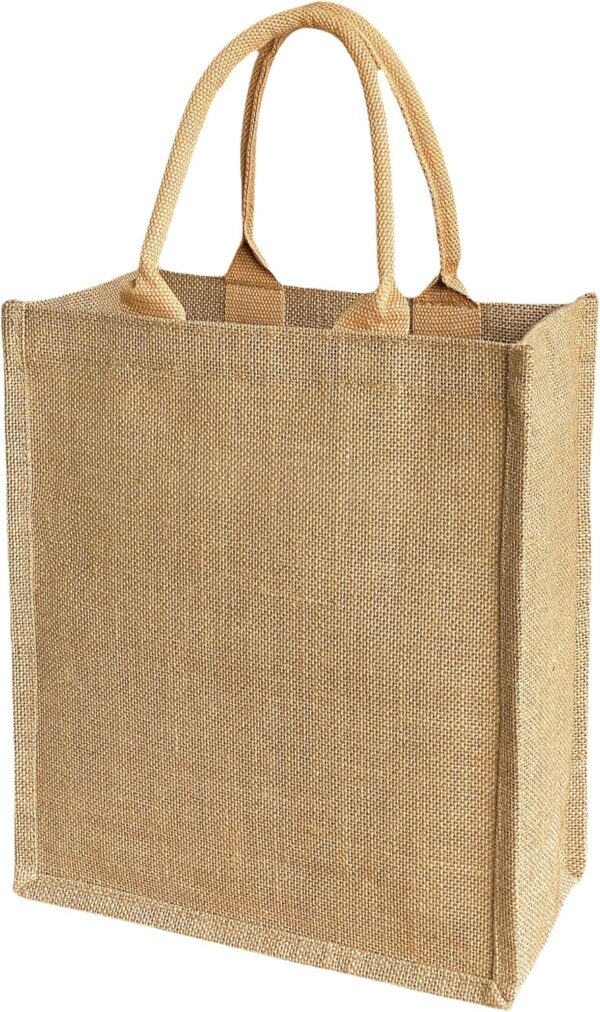
A jute bag can look natural while its finish changes how it feels, prints, folds, and behaves in use. Two short words in a product description—“singed” and “laminated”—are therefore not a complete technical specification. Xiangfu’s product listing presents a “Custom, Singed & Laminated” jute tote design, while the wider jute-bag page lists natural, bleached, or laminated jute among its options. For an overseas buyer, that is a useful starting point, not proof of a defined resin system, layer construction, water-performance rating, or end-of-life route.
The safer development sequence is to define the finish, approve a controlled swatch, test the finished bag, and then transfer the approved result into the purchase specification. This prevents a familiar finish word from becoming an unintended promise.
What singeing should mean in the development brief
Singeing, also called gassing, is a textile finishing process intended to produce a more even surface by burning off projecting fibres, yarn ends, and fuzz. Encyclopaedia Britannica describes the material passing over a gas flame or heated copper plates quickly enough to remove loose fibres without scorching the main material.
For a jute-bag project, use that definition as a process concept rather than a performance claim. Ask which jute component is singed, on which side, and at what stage relative to cutting, printing, lamination, and sewing. Define the visual target: less loose fuzz, a cleaner print area, a more even hand, or a particular reference sample.
A singed surface should be checked for scorching, dark marks, brittle yarns, holes, uneven hairiness, and edge-to-edge variation. If the bag will be printed, compare print sharpness and ink adhesion on the finished surface, not only on fabric. Singeing may alter appearance and hand, but does not establish abrasion resistance, load capacity, water resistance, or cleaning durability.
Lamination is a construction to specify, not a synonym for waterproof
“Laminated” can describe a textile combined with a film, membrane, or polymeric layer. Do not approve the word without recording what is laminated to what. Confirm whether it is jute plus an internal film, a back coating, or a multi-layer assembly; which face is exposed; whether coverage is continuous; and whether the layer reaches seams, gussets, handles, and folded edges.
The product page does not identify the resin, film gauge, adhesive, coat weight, layer position, or percentage of added material. A photograph of the inside cannot fill those gaps; the layer specification and representative sample must do that work.
Ask for the resin or film family by name, not only “eco lamination.” Request polymer type, adhesive use, nominal thickness or coat weight, colour and opacity, and any restricted-substance or food-contact requirement. If a trade formulation is confidential, request a material declaration or controlled internal code tied to the approved sample and production lot.
Define the buyer’s finish target in observable terms
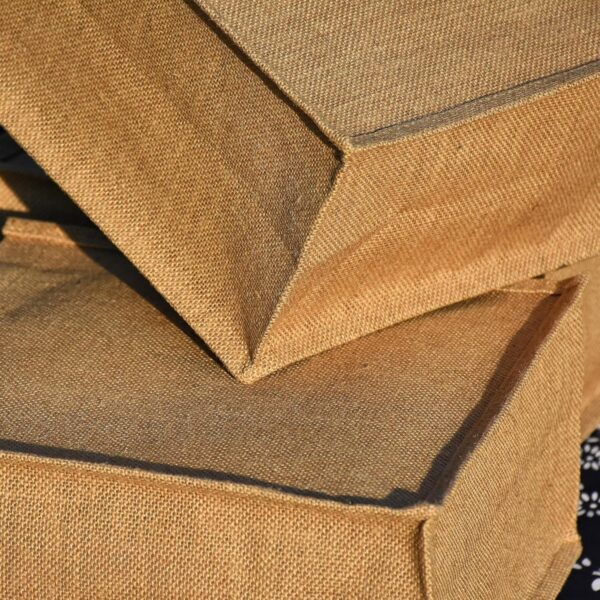
A finish brief should translate “natural,” “soft,” or “premium” into checks that two parties can see or measure. Record face and reverse appearance, gloss or matte preference, colour shift, surface noise, stiffness, fold memory, odour, and tactile feel. State whether the laminate may be visible at the mouth, seams, folds, or handle attachments.
Decide what trade-off is acceptable. A heavier layer may improve shape retention while reducing drape; a softer construction may preserve textile feel while offering less barrier protection. A clear film may preserve jute appearance but show bubbles, wrinkles, or adhesive marks. These are development choices, not assumptions to hide in a quotation.
Move from swatch to finished-bag validation
A swatch is necessary but not sufficient. Request a swatch that identifies the jute base, singeing status, lamination side, layer code, and intended print process. Approve it against a retained reference under consistent light. Then request a representative finished sample using the intended panels, seams, gussets, handles, logo, labels, and packing method.
The finished-bag review should include visual uniformity, seam and edge appearance, laminate adhesion, delamination or bubbling after flexing, odour, fold recovery, and handling marks. Select tests according to intended use and claim language. Possible checks include defined water-contact or leakage, rub and flex, print adhesion, seam integrity, dimensional stability, and odour or restricted-substance screening. Write down the protocol, conditioning, sample locations, limits, and responsible party before testing.
Do not convert a passing splash observation into “waterproof.” Separately, do not convert a natural jute base into a biodegradability claim for the complete bag, or call the complete bag recyclable merely because one component may be recyclable. For U.S.-market wording, the FTC Green Guides summary cautions against broad, unqualified environmental claims and ties degradability claims to evidence for the entire item in its customary disposal environment. Other destination markets need their own review. Approve performance claims and environmental wording separately, after the relevant evidence is available.
Finish and BOM confirmation table
Use the following table as a development record and require the supplier to complete the blank fields before sampling approval.
| Item to confirm | Supplier response / evidence required | Buyer approval condition |
|---|---|---|
| Jute base | Fibre/material description, weave or construction reference, lot or mill code | Matches the approved base swatch |
| Singeing | Component treated, face(s), process stage, visual target | No unacceptable scorch, holes, brittle yarns, or uneven fuzz |
| Lamination layer | Resin or film family, internal code, colour/opacity, adhesive if any | Code is traceable to the approved sample and BOM |
| Layer structure | Cross-section or drawing showing jute, film/coating, adhesive, and exposed face | Layer position and coverage match the drawing |
| Layer coverage | Main panels, seams, gussets, folded edges, handle areas | No unapproved exposed or missing areas |
| Surface target | Hand, gloss, stiffness, odour, colour and appearance reference | Signed swatch and retained visual standard |
| Printing interaction | Print method, ink/film compatibility, logo location | Print remains legible and bonded on finished material |
| Finished-product checks | Test method, conditioning, sample size, limits and report owner | Results meet written pass/fail criteria |
| Production control | Incoming material checks, lot identification, change notification | No resin, film, supplier, or process substitution without approval |
| Performance and environmental wording | Exact claim, relevant test/evidence, destination market and disposal context where applicable | No waterproof, recyclable, biodegradable, or compostable promise before appropriate verification |
A practical approval gate
Before releasing a bulk specification, keep four records together: signed swatch, layer sketch, completed BOM, and finished-bag test report. Any change to resin, film, adhesive, singeing stage, surface treatment, print system, or seam construction should trigger a review sample. Compare finish options on the same bag pattern and logo, not a loose fabric square.
The central purchasing question is not “Can you make a laminated jute bag?” It is “Which controlled construction will you sample, how will we recognize it, and what evidence will release it?” That question creates a usable OEM/ODM record while keeping unverified capability and environmental performance out of the promise.
For a Xiangfu development enquiry, send the intended contents, destination market, finish reference and proposed acceptance checks. Ask which construction can be sampled and what material evidence can be supplied before committing the final specification.